Glosses
on writing

My dear 204 followers,
Please find documentation of my show Writing at Giovanni’s Room here.
What follows are some thoughts about certain pieces in the show. All images courtesy Jeremy Maldonado at Giovanni’s Room.

I made this piece in 2023. It is knit with 4/24 nm silk, i think loro piana makes the yarn. I have a lot of it, in many colors; colourmart had a big shipment years back. It’s a fantastically weird yarn; it’s spongy, matte for a silk but still shiny . . . it behaves like a much thicker yarn than it actually is. It has been a bedrock of my work. I was looking at the work of Tony Feher at the time. Feher made assemblages with everyday things—styrofoam, plastic, glass jars and bottles. He uses marbles often—red marbles held in the mouths of green beer bottles arranged in a circle, clear glass jars full of multicolored marbles. I bought these glass marbles on eBay, wedged them between the wood and the fabric. There are twelve, a quorum. To me they are symbolically overloaded in lovely ways, abetted by the simple beauty of clear glass. They are cast lots, numeric aids, scrying balls. I’ve loved this piece for a while and am happy it’s found a home in this show. It’s the first work I made that successfully incorporated something beyond the textile & the stretcher.
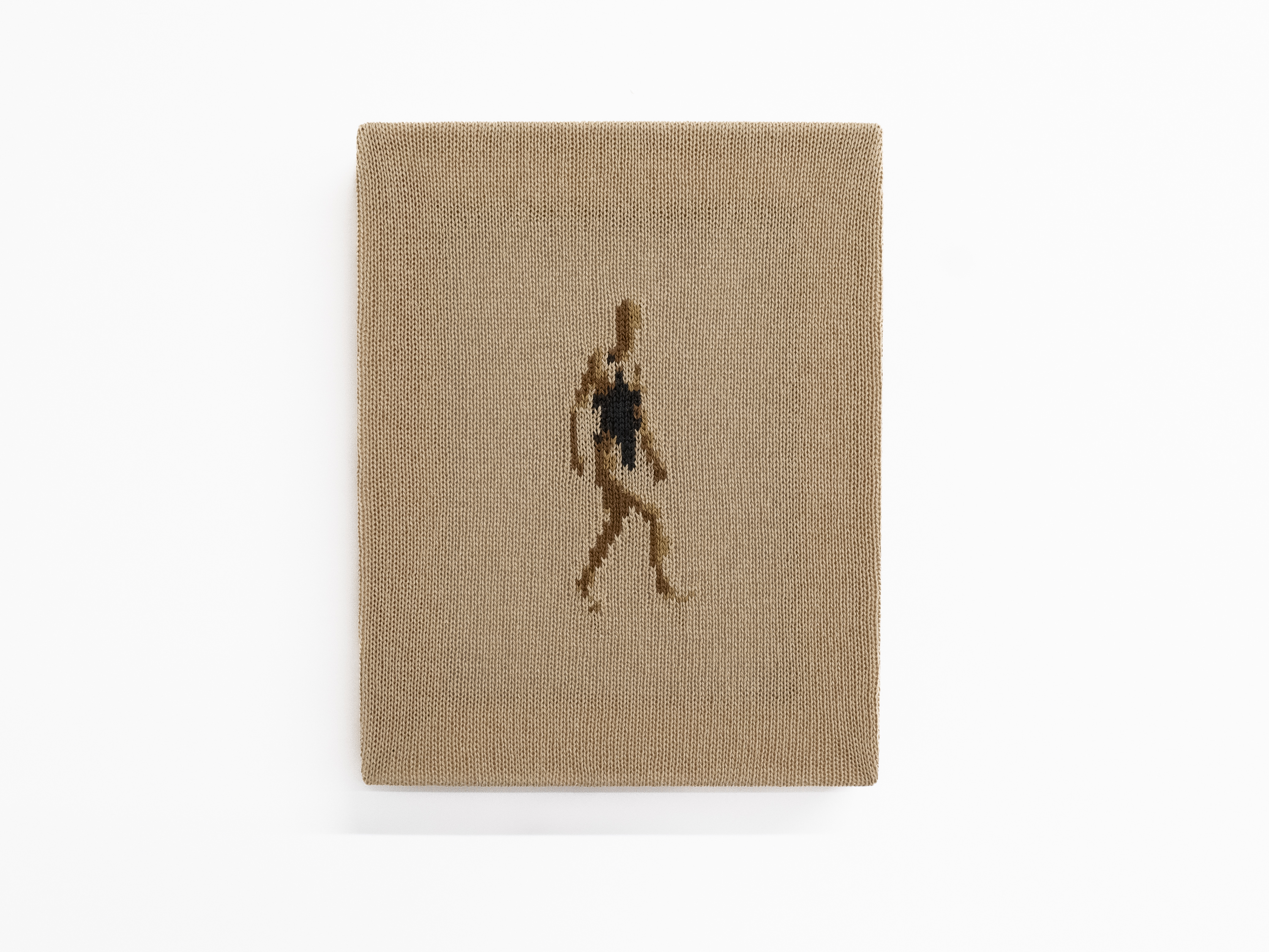
These are the same loro piana silks, although the dark green of the leotard of the figure is actually a different yarn, it’s a ‘wild’ silk which means the silk was harvested from cocoons whose moths had already hatched, rather than the usual method of boiling the cocoons to kill the creature inside. In my practice, a huge conceptual beast has been the difference between clothing and art. I won’t get into that here. But at the outset of planning this show, I knew that I wanted to make some bridge between the clothing / self-portraiture and the painting-esque wall works. This was a first effort to that end. The leotard is one I made in 2020 or 2021, when I was still living in Riverside. In hole-punch lettering it says SPORE down the front. On the back is an oak-like tree. Many people have commented on what the figure reminds them of— bigfoot, Julianne Moore on the poster for SAFE, the Simon & Schuster logo. It is difficult to get the resolution right on a work like this—I am proud of this one, I aim to make more in its wake, pixelated & knitted invocations of film-still self-portraiture. The figure wears a mask to become faceless. This I have understood to be an essential step in the lyric figuration that grounds my work.
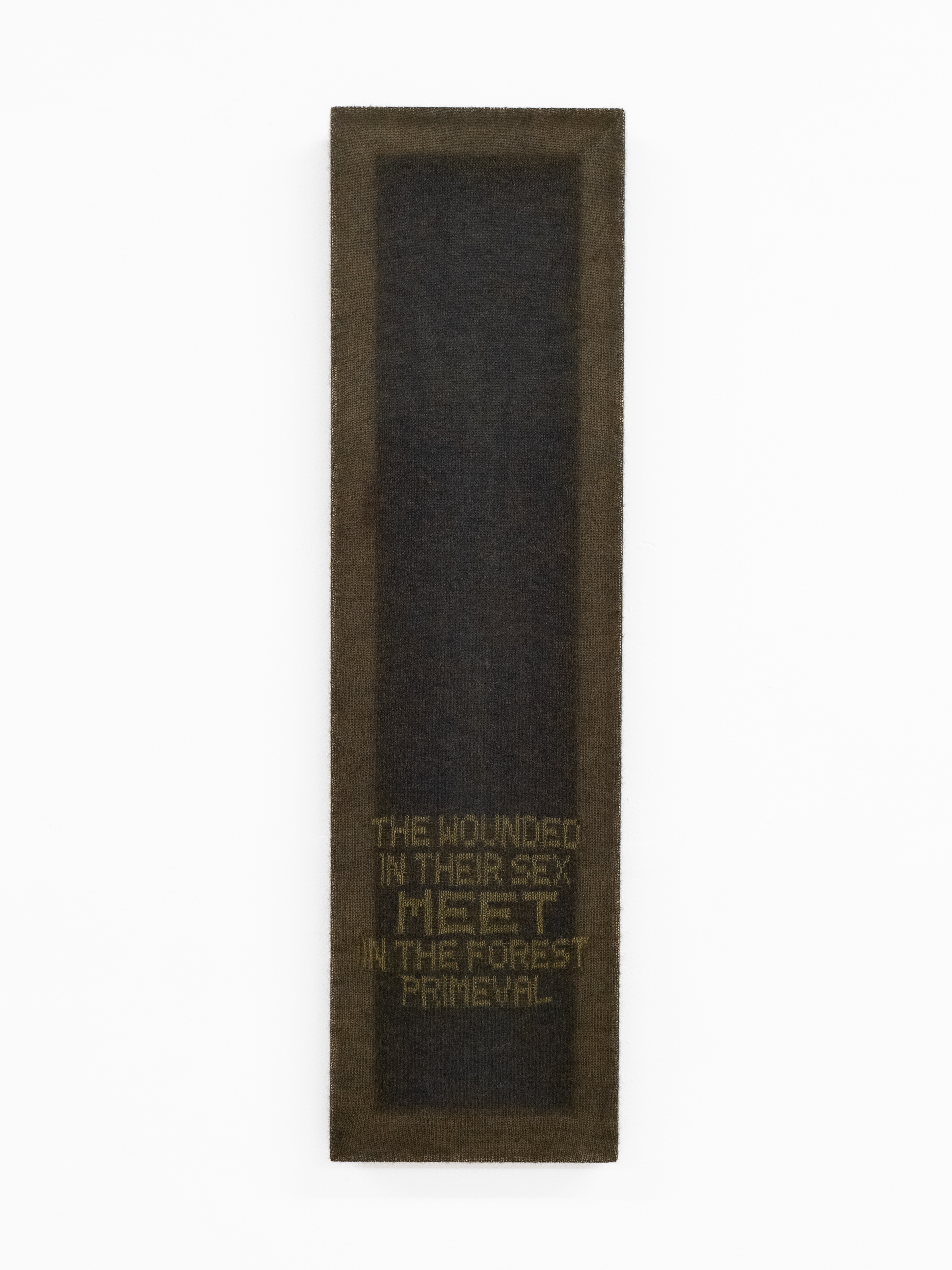
This text comes from the novel Nights in Aruba by Andrew Holleran. The protagonist, a Holleran stand-in, and a foppish friend of his, both near forty, both from near Gainesville originally and now living in NYC, have returned to Florida for a few weeks to check in on their aging parents (it is the early 1980s). They go for a walk together in a park and come across two old women on a bench and speak with them. The friend is chipperly gagged as they part, over the moon as he makes meaning of it all—“‘Lesbians!’ he said. ‘We found two lesbians in the forest! On a Tuesday afternoon in Jasper! It makes sense, doesn't it? They too wanted to be alone, so they went to the woods. They both left their husbands in Miami for each other and are now settled in Fort Green. Amazing!’ he said. ‘The wounded in their sex meet in the forest primeval.’"
In back, I’ve made an oil pastel on raw canvas drawing of a palm tree, or a fountain, or a firework. The movement into nature to escape the dousing eye of authority is an essential theme in my work. What is found there in the forest primeval is of course much more than the healing of the sexual wound, though that can be found too. “The wounded in their sex”—syntactic flourish to let negative judgment unfurl into somehow majestic conceptual free-for-all, to me.
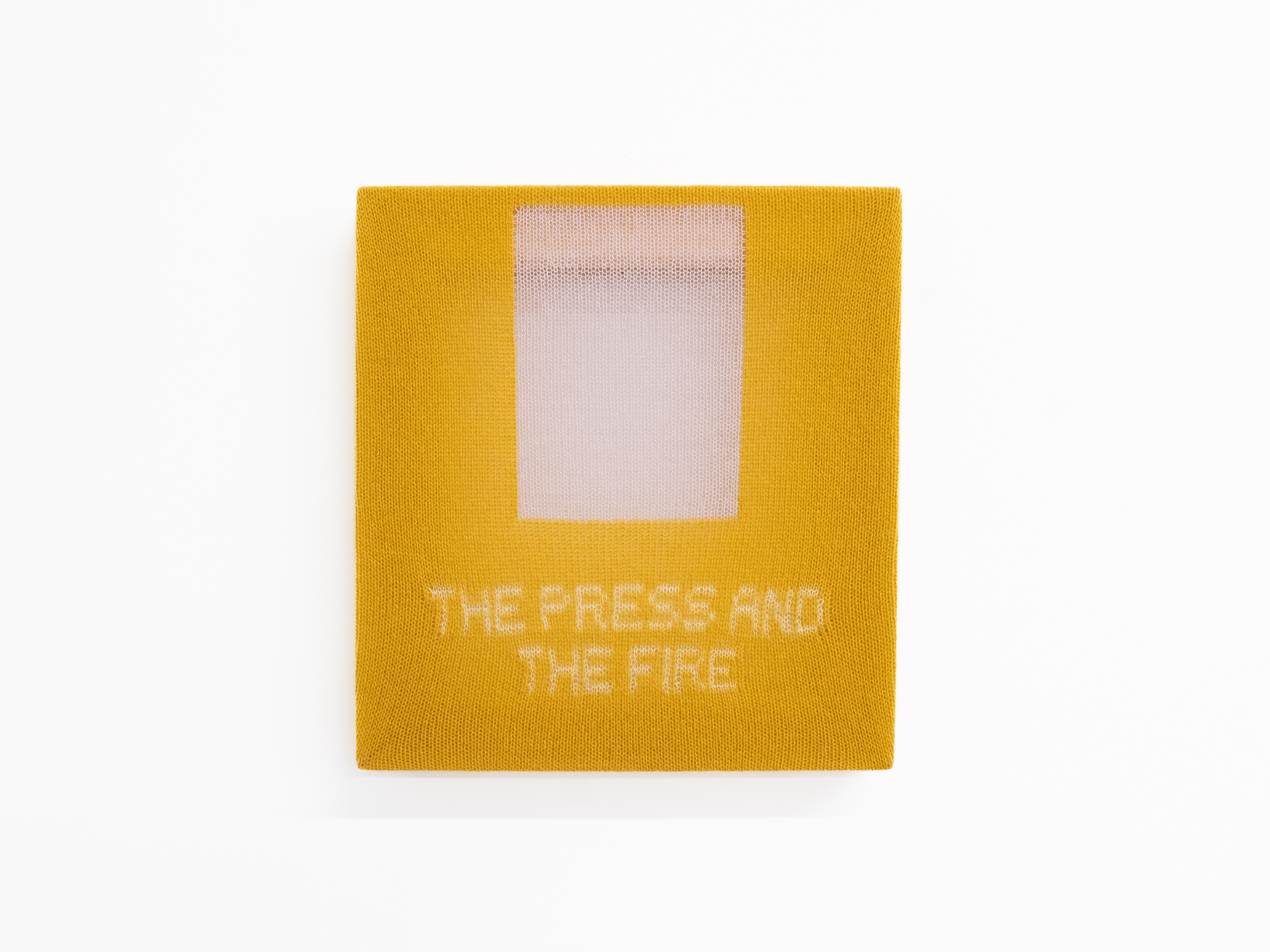
The text comes from a letter John Donne sent to a friend of his. Donne had written a text called Biathanatos, a semi-satirical treatise in defense of suicide. It is the sort of essay that is almost fractal in its ironizing (no, I have not read it . . . ). Of the unpublished manuscript, Donne writes, “Reserve it for me if I live, and if I die, I only forbid it the Press, and the Fire: publish it not, but yet burn it not.” This refusal to decide, this desire for one’s work (and as corollary, one’s life) to remain in a private sphere prior to both publicity and destruction—I think my work is often thematizing this experience, the wiggle-waggle of spirit, the positive experience of deep uncertainty, perseveration as true-to-life embodiment.
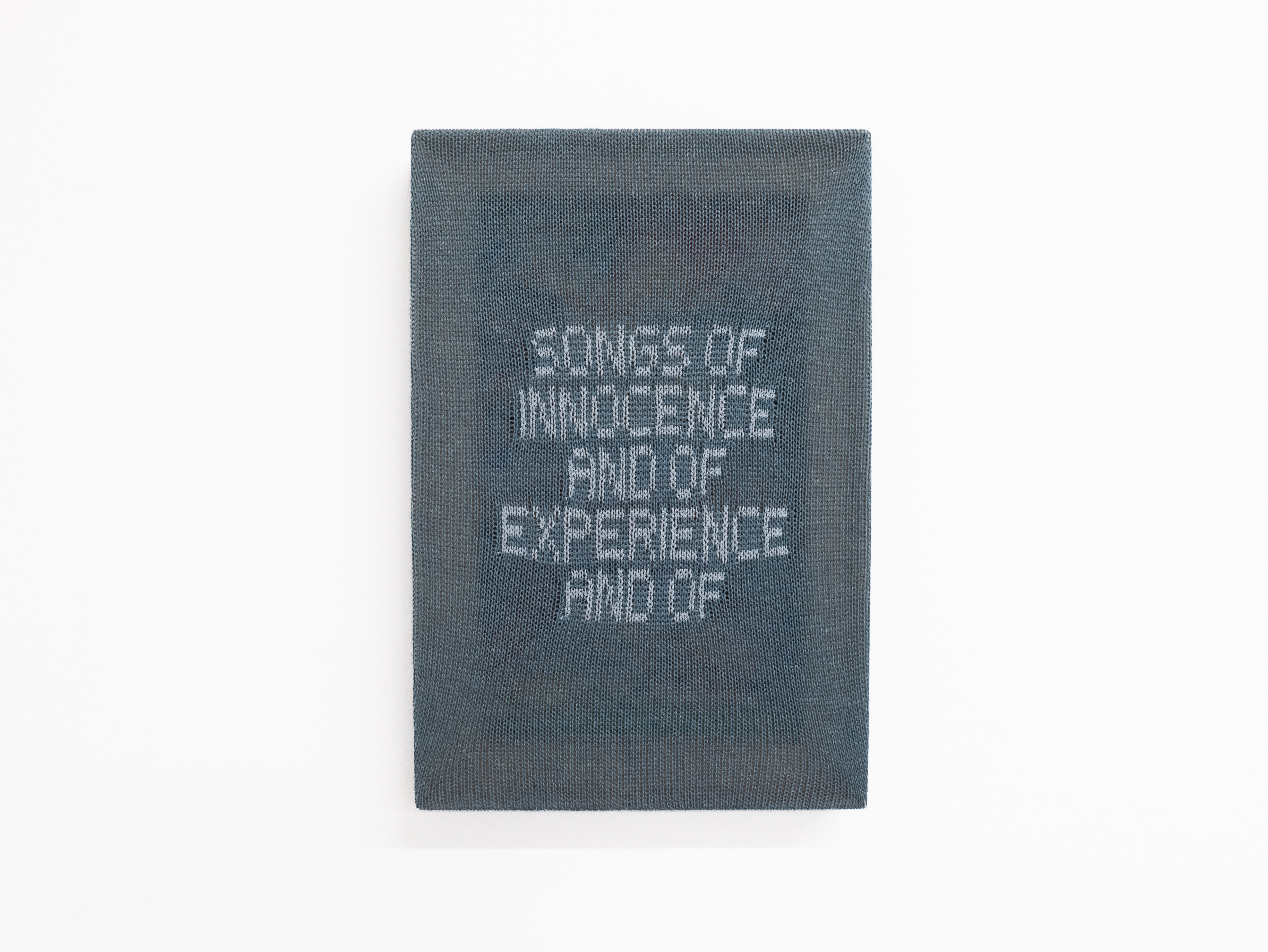
This one is called “The Sequel,” of course of William Blake’s Songs of Innocence and of Experience, of whose frontispiece I’ve scribbled a loose facsimile that just shows through from behind. AND OF . . . it’s a joke I’m making, a joke that welcomes, requests participation in an endless scheme . . . if there’s an articulable ‘energy’ to the work I make that most compels me, it’s this conceptual irresolveability, the refusal to conclude, a perpetually opening gate on something. I think this piece also gets at something in Blake, the restlessness of vision, the individuation of song. In an interview, Paul Metcalf mentions someone once said to him, “The only real work in creative endeavor is keeping things from falling together too soon.” I love that . . . Metcalf goes on to say that when you do finally let them fall together they better CLANG. Anyway, let it clang and clang and clang and clang and clang, —
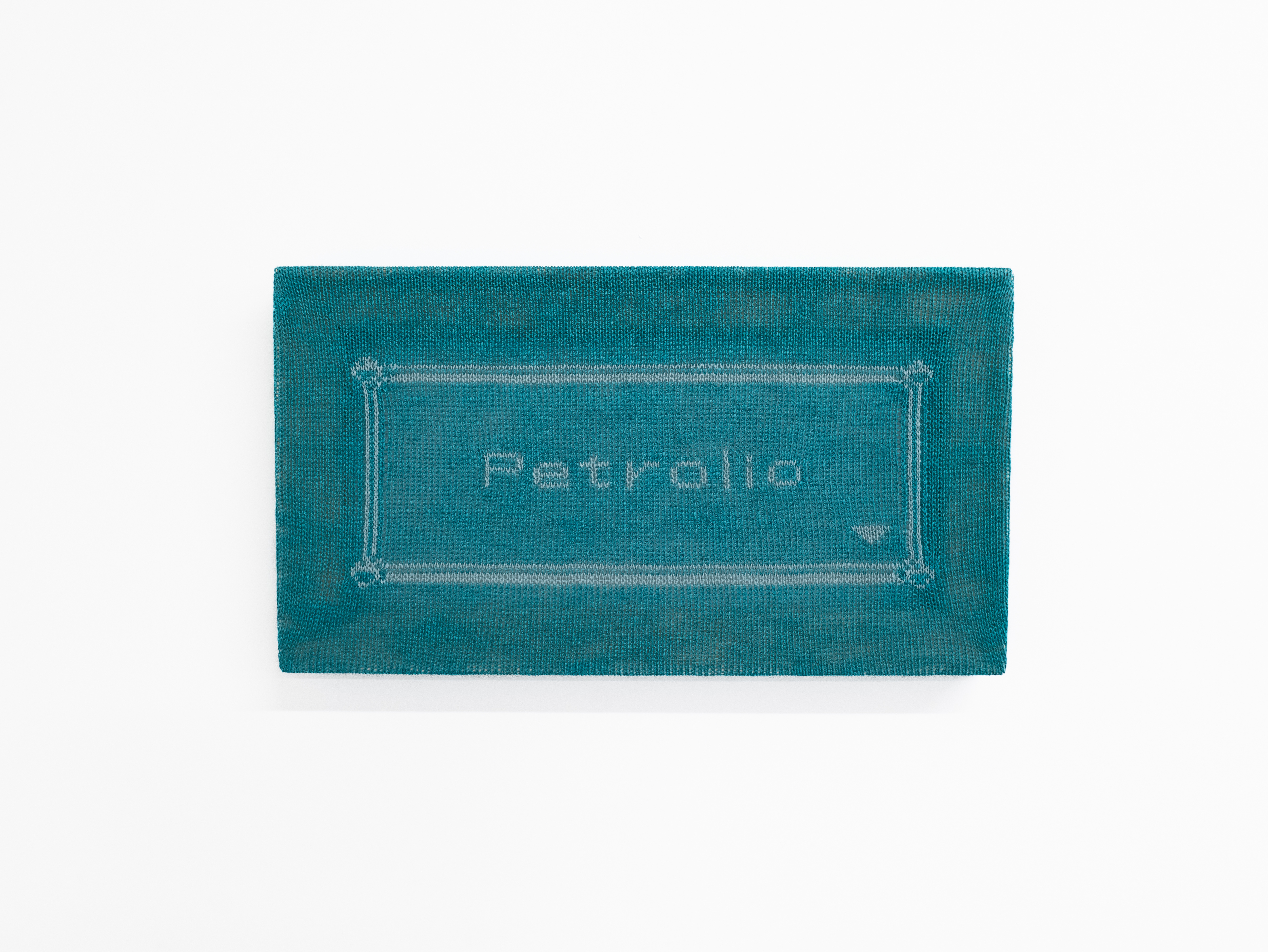
When people ask me lately what I’m reading I’m usually at a loss, because the answer is the first ten pages of thirty-odd books. What am I reading? Petrolio by Pier Paolo Pasolini, The Bell by Iris Murdoch, The Death of Friends by Michael Nava, Berlin Atomized by Julia Kornberg, Family Life by Akhil Sharma, Middle Passage by Charles Johnson, Medusa of the Roses by Navid Sinaki, At Swim, Two Boys by Jamie O’Neill, Punks by John Keene, Lote by Shola von Reinhold, The Shards by Bret Easton Ellis, Tenderness by Derrick Austin, City of Night by John Rechy, Lies: A Diary, 1986-1999 by Ned Rorem, South Flight by Jasmine Smith, Stubble Archipelago by Wayne Koestenbaum, Chevengur by Andrey Platonov . . . I draw this up kind of as an excuse for how could I have the TEMERITY to make this work having read about ten pages of Petrolio, but I think I also mean to say that many of these books I’ve listed, some of which I’ve read no more than two pages of, have still changed my life, as it were!!!
Ok so this work . . . deep oversaturated electric teal hemp. The text box and font from Pokémon Red / Blue. And the title of the unfinished novel Pasolini was working on when he was murdered, a sprawling strange beautiful magnum opus about . . . well I’m not sure yet. 1975 (Pasolini dies) to 1997 (Pokémon comes stateside), the span of so very many things . . . again, the purpose is to keep things apart, let them clang together, let the clanging be the frictionless, infinite labor of the viewer . . . .
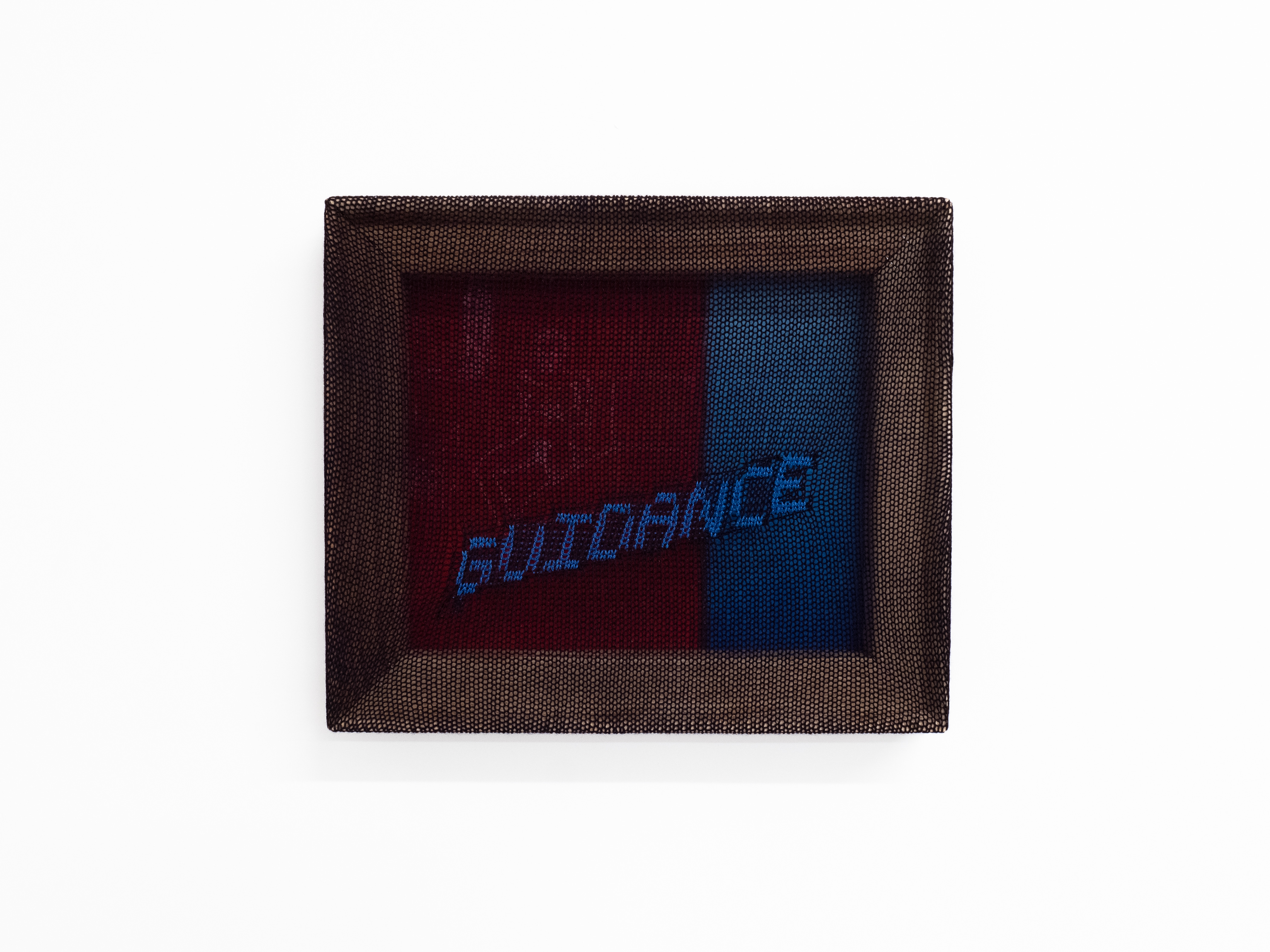
I knitted this work in 2023. It was maybe going to be a part of Commonplacing in NYC at The Meeting but we decided against it. I’m glad we didn’t show it then because in pulling this show together I decided to do this oil pastel on canvas to place behind it. I’m satisfied with how this one came out. It’s hard to photograph, but the color intensities and the optical strangeness of the textile come together well in person. There is a faint sketch in white on the red portion of the naked Pasolini reading by his bed as photographed by Dino Pedriali a few weeks before Pasolini’s death. It’s a series of photographs I love, in part for the almost paternal salaciousness of the dangling dick, like yes you may see gay boy, yes you may see—and then the sensuality of the reading figure in repose, the tragedy / calamity of his murder very slightly tempered by the serenity of the poet filmmaker sex genius at work at home . . . .
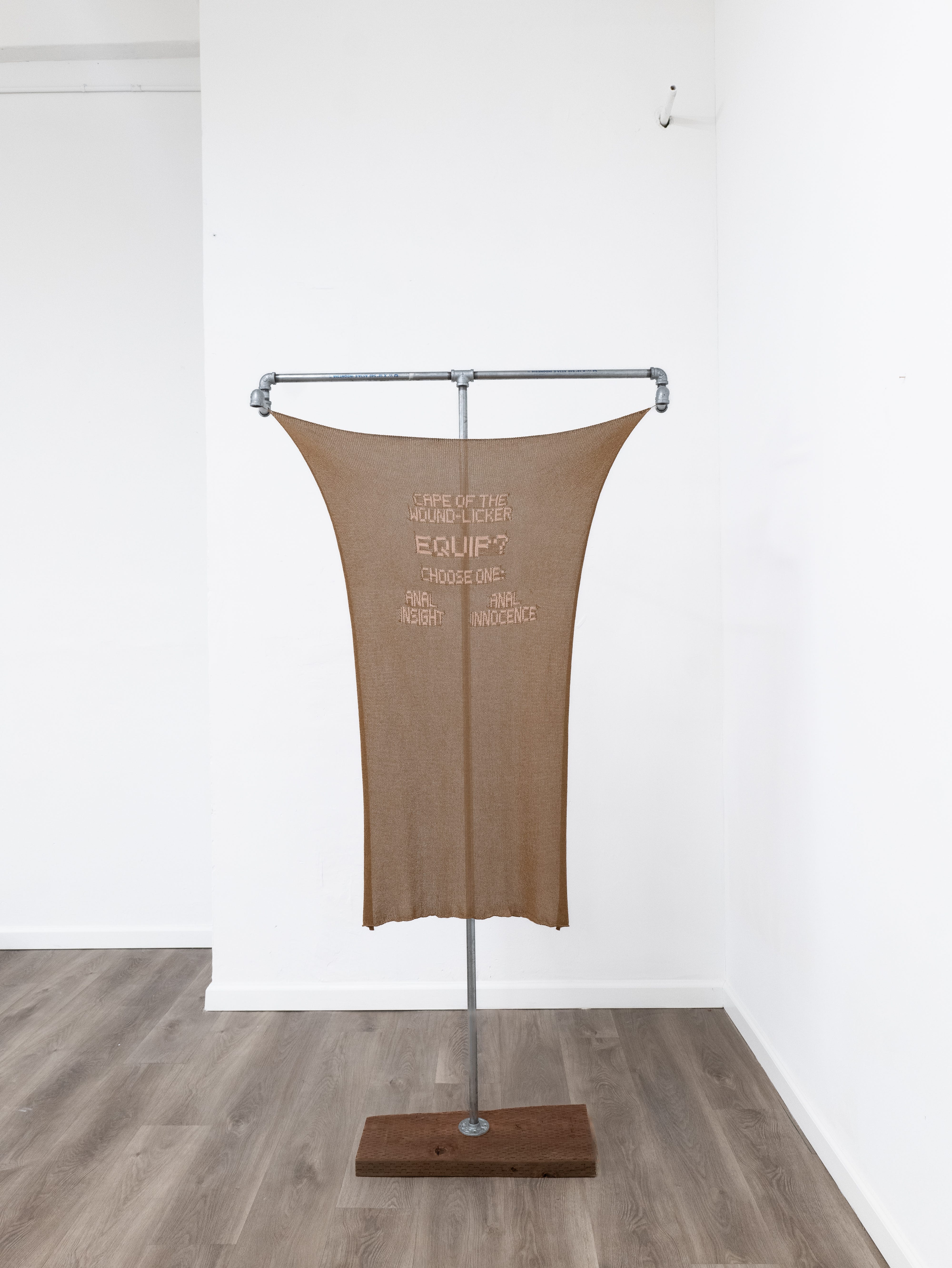
Again that loro piana silk. With linen/ramie text, a pale peach. Plumbing and pressure-treated lumber I got at home depot to form a povera figure-sculpture-display. A friend recently said of this, “but . . . suppose you achieve anal enlightenment, what then? Maybe there are anal bodhisattvas who walk amongst us . . . .”
I think I wish to conclude this post by saying that in the course of composing this show called “Writing,” which is about transmission, the construction of conceptual irresolution, correspondence, prehensile penetration, pleasure, the deep horrific insufficiency of everything in deadly dark times, the plasticity of language, the history of textiles, and openness, I have found myself saddled with new and interesting problems that subsequent shows will continue to elaborate . . . stay tyuned . . . . <3